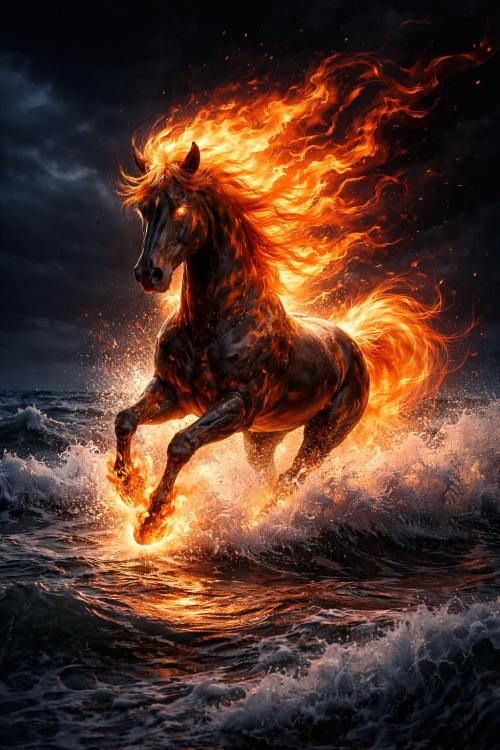
The winter storms bring wild and beautiful horses thundering dangerously out of the rolling sea, their nostrils flared, their flying manes splaying white foam high into the sky. From this watery birth they are galloping with powerful heat through our quiet routine bringing a new and formidable year into birth, the year of the fire horse. As the Chinese new year approaches we will be leaving behind the introspective snake year of shedding, and heading into action, movement, authenticity, self-expression and living more honestly in the year of the fire horse.
Horses are important symbols in mythology and often are linked with water as a representation of the otherworld. They are also said to represent the sun – in Irish ‘Echdae’ the horse of the heavens. This comes from ancient myths where fire-breathing horses drew the chariot of the sun across the sky.
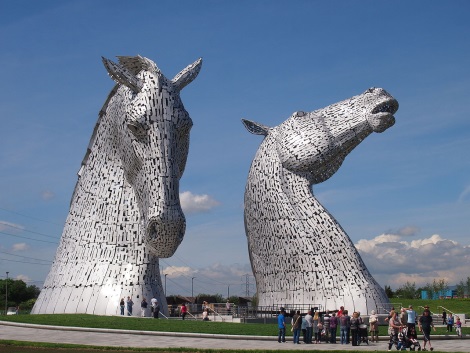
‘The Kelpies’ in Scotland (Falkirk) is a sculpture of two magnificent horses with eyes of fire. Kelpies are water horses who are found in Scottish lochs, but they are actually spirits. In Celtic folklore there are many tales of shapeshifting water horses, found in rivers, lochs and the sea. They have a pretty dangerous reputation and are said to lure people or animals to their deaths and then eat them! In Wales there is the flying Ceffyl Dŵr horse who is also a shapeshifter and may be found near waterfalls or lakes. In Ireland the Each Uisce (associated with the sea, especially around Samhain) was thought to be half horse, half eel. Another Irish water horse is the aughisky, which is similar to the Scottish kelpie.
Across the Celtic world, the goddess of horses is known as Epona, and is associated with the journey to the otherworld as a symbol of transformation, also fertility and sovereignty. Rhiannon is related to Epona and is a Welsh queen who rides a white horse. Following the Celtic calendar, there is a celtic astrological sign ‘the white horse of summer’ which relates to the holly month of July. It is said to be a wild, fierce and magical creature, as is another mystical equine being, the unicorn, which is of course the national animal of Scotland.
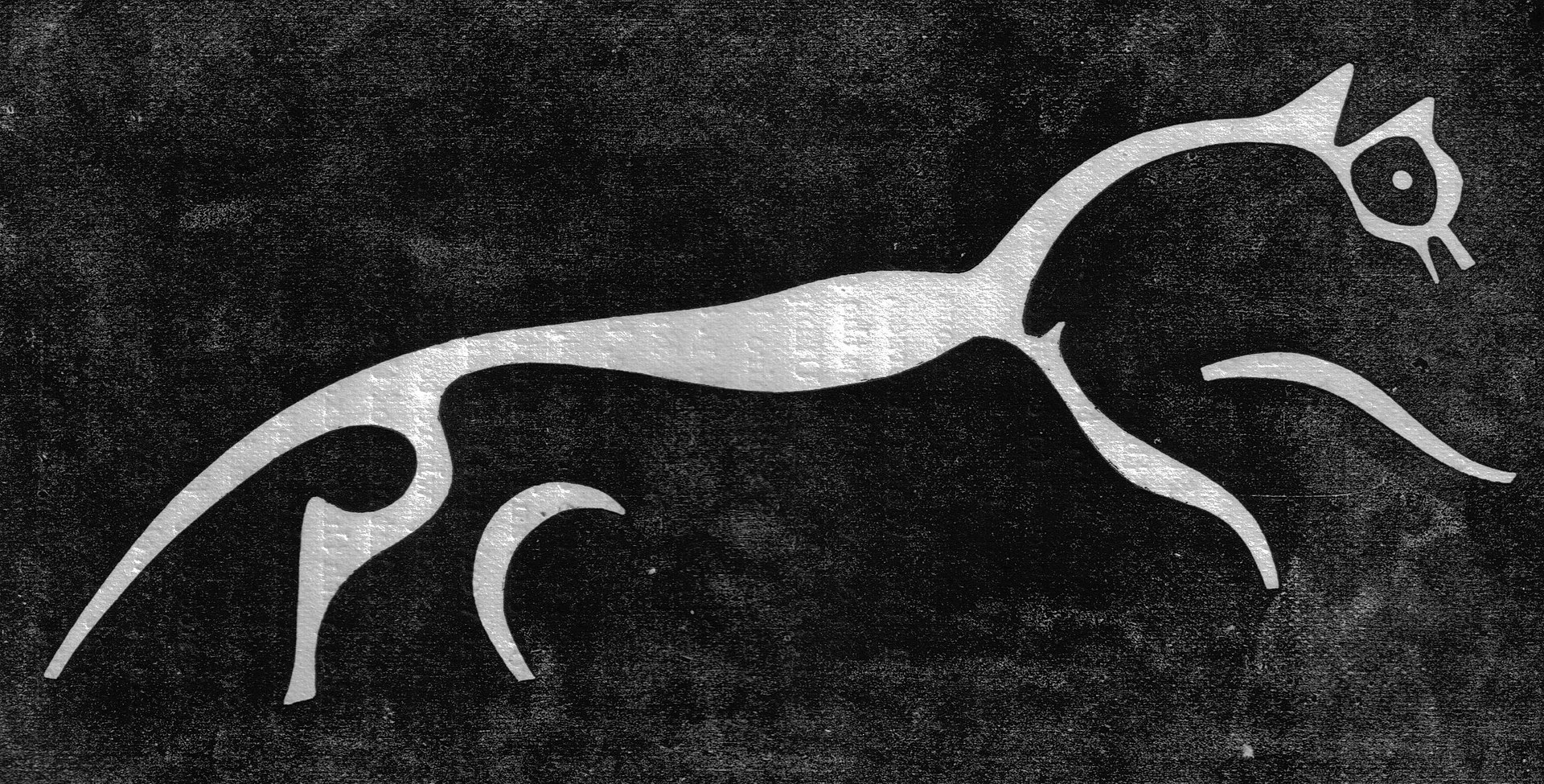
Along the Ridgeway near Oxford there is the magnificent chalk horse carved into the hillside. The Uffington White Horse is the oldest horse figure in Britain, originally carved during prehistory possibly with tribal symbolism. This iconic figure is loved by many and remains visible thanks to the people of the area who have maintained it over generations.
A mile or two along the Ridgeway is Wayland’s Smithy, a Neolithic tomb, which has existed since the 10th Century AD. Metalworking has a sense of mystery and magic about it, and the myth of this long barrow is that if you were to leave your horse tethered there, you would find it reshod on your return (if you left a coin!).
The Celts were apparently the first culture to develop the horseshoe (later used by the Romans) and both horseshoes and horse halters are said to contain luck. Horse ownership was seen as a status symbol – a nobleman was defined as owning arms and a horse. Warriors were often buried with their horse, and horse bones were found in Newgrange burial chamber, Co. Meath.
Back to the present day, where horses are giving up their lives for our wellbeing in a shockingly invisible way. If you are of menopausal age, you may be looking at options for HRT (Hormone Replacement Therapy) to calm some of your symptoms. For many years HRT has been derived from pregnant mare’s oestrogen (Conjugated equine oestrogen or CEE, previously sold as Premarin). Research has found health risks linked with the use of equine metabolites (See the Women’s Health Initiative Study 2002). However a ‘bioidentical’ product matching the human hormone is available, known as oestradiol, made from plant sources such as soya or wild yam. Both these forms of HRT are currently available on prescription (but note that Premarin is no longer branded with that name). The extraction of the CEE hormone involves keeping the mares continually pregnant, confined in small stalls – PETA (People’s Trust for the Ethical Treatment of Animals) highlight the issues here. You might choose instead to look at herbs to support menopause, follow this link to the amazing Seed Sistas. There are also some great wild yam products available to buy without prescription that women have found really helpful. So if you are using, or thinking of using, HRT do check what you are being given or do your own research.
Let’s honour and respect the beautiful and majestic horse, this year’s animal sign in Chinese astrology, we may have much to thank her for.
For references see below.
If you enjoyed this, please like and share. Click below to subscribe for free to my regular posts (normally every few weeks). You can unsubscribe at any time.
I am an artist, musician and orchardist living on the Gower Peninsula. I am writing this blog to share with others the power and joy we can feel as we immerse ourselves in nature recovery. By returning to our mother earth, I believe this will lead us forward into a more sustainable way of living. Self care and community care are vital to develop our resilience and then from a more grounded base we can create the world we want to see, starting with small and possible actions.
All photos and text are the copyright of Witchhazel Wildwood unless otherwise stated.
References and photo credits:
Shilsley.co.uk
Moonfishwriting.com
West Cork People
Wild Atlantic Way
English Heritage
Oxford Archaeology
Seed Sistas: https://seedsistas.co.uk/2025/07/28/best-herbal-alternatives-to-hrt/
British Journal of Clinical Pharmacology
Women’s Health Initiative Study 2002
PETA (People for the Ethical Treatment of Animals)
The Kelpies in Falkirk (photo © Beninjam200, WikiCommons)
Uffington White Horse (sketch William Plenderleath: The White Horses of the West of England 1892)
 Wildwood Edge